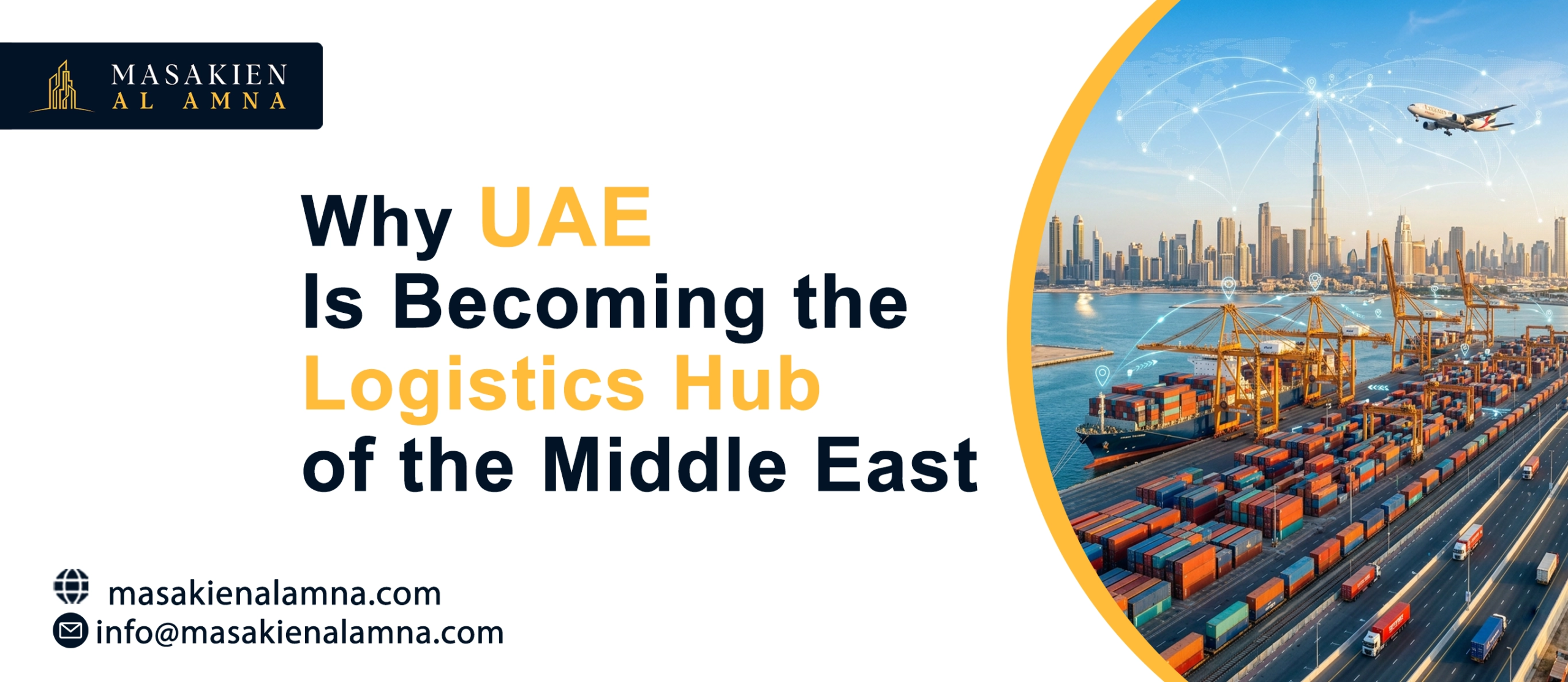
The United Arab Emirates (UAE) has, sort of, changed itself into one of the world’s most influential logistics and supply chain destinations. It used to be known mainly for its oil reserves, but the nation has gradually diversified its economy by putting a big effort into ports, airports, free zones, smart infrastructure, and modern transportation networks. Nowadays, the UAE operates like a major gateway tying together Asia, Europe, and Africa, so it’s become one of the busiest places for trade and logistics across the globe.
And because international businesses are always looking for faster, more dependable, and cost-effective supply chain options, the UAE keeps pulling in multinational corporations, makers, e-commerce companies, and logistics providers. Government initiatives, business-friendly regulations, plus ongoing infrastructure upgrades have all helped strengthen its role as the logistics hub of the Middle East. In this blog, we’ll look at the main causes behind the UAE’s quick momentum in logistics, and also why so many companies around the world pick it as a regional distribution base.
The Strategic Geographic Location of the UAE
A major factologistics and logistics success is its positioning, basically its geographic advantage. Placed at the crossroads of Europe, Asia, and Africa, the UAE lets businesses reach almost two-thirds of the world’s population in just an eight-hour flight. That unusually good location trims down transport time and also helps lower shipping costs for cross-border trade.
The country also sits pretty close to a few of the world’s most active shipping corridors, especially the Strait of Hormuz, through which a big chunk of global oil and cargo shipments flow daily. Time and placement give companies a real edge to shift goods between continents in a more efficient way and, at the same time, keep delays down a notch. So import-export businesses tend to benefit a lot from this natural connectivity, almost like it’s just there waiting for them.
Also, the UAE works as a sort of ideal redistribution point for GCC nations like Saudi Arabia, Oman, Kuwait, Bahrain, and Qatar. When products show up at UAE ports, they can be transported across the region quickly, thanks to well-developed land routes, air links, and sea routes. This local accessibility is one of the reasons the UAE has become a must-have logistics destination; people basically rely on it.
On top of that, international companies that want a Middle East foothold often pick the UAE because it gives direct reach to regional markets without needing several separate operational hubs. That choice helps streamline the supply chain and can also cut day-to-day operating costs, while usually making customer delivery schedules better and faster too.
World-Class Ports and Maritime Infrastructure
The UAE has put billions of dollars into building some of the most modern seaports around. Jebel Ali Port, for instance, has become a global reference point for efficiency, automation, and the ability to handle cargo. In practice, these ports can take the world’s biggest container ships, which means businesses can import and export goods on a very large scale.
Modern port setups are packed with automated crane systems, digital customs processes, smart cargo monitoring, and logistics services that are actually integrated. These tools tend to lower the time needed for loading and unloading while also reducing the chance of operational missteps. Because of that, shipping firms usually get quicker turnaround cycles, and everything keeps moving. Check out our latest blog post on How Smart Logistics Is Transforming Supply Chains in UAE
Advanced Airport Cargo Facilities
Air freight keeps a pretty big spot in modern logistics, especially when the goods are high-value, very time-sensitive, or perishable. In this sense, the UAE has basically positioned itself as a top air cargo center globally, thanks to airports like Dubai International Airport and Al Maktoum International Airport, which are well known internationally.
These locations run cargo terminals with automated handling systems, temperature-controlled storage areas, dedicated pharmaceutical logistics resources, and express shipping services. With this kind of setup, companies can move delicate items in a safe way while still following international quality expectations, not just local rules. honestly,
Another key factor is the solid connectivity coming from global airline networks. Cargo can be shipped to hundreds of overseas destinations with short transit windows. That broad reach supports sectors such as healthcare, electronics, fashion, automotive, and e-commerce, and honestly, these industries often need a fast and dependable movement of goods
Also, the way airports connect with seaports and road corridors really boosts supply chain efficiency. Firms can transfer shipments between multiple transport modes without too much friction, which cuts down on delays and supports better delivery results both inside the country and abroad
Government Support and Visionary Policies
The UAE government has taken an important role in developing a logistics environment that can compete worldwide. Using long-term economic diversification plans, public authorities have poured resources into infrastructure, technology, transportation services, and trade facilitation, aiming to reduce the country’s reliance on oil revenues
Business-friendly policies help draw international investment because they keep things a bit easier, like licensing becomes simpler, the bureaucratic hurdles are reduced, and the regulatory framework stays clear. In practice, this ends up making a fairly attractive business environment for logistics firms that want to set up regional headquarters.
At the same time, government initiatives for digital transformation have pushed paperless customs procedures, electronic documentation, blockchain trade systems, plus AI-driven logistics management into everyday operations. These tools improve operational efficiency; they also shorten processing times and lower administrative costs. Overall, it feels smoother for companies handling cross-border movement.
Looking ahead, future-oriented national strategies still put logistics at the center—along with smart mobility, sustainability, and innovation. This proactive direction helps the UAE stay ready for changing global supply chain pressures while keeping its strong leadership position in the Middle East.
Free Zones That Boost International Trade
The UAE has many specialized free zones, made specifically to support international trade and logistics businesses. Generally, these zones offer benefits like 100% foreign ownership, tax incentives, simplified customs procedures, and faster company registration, without all the extra friction.
They are located near airports, ports, and industrial areas, so businesses can reduce transportation costs and run operations with less delay. Firms that operate there often get quicker import-export processes, plus more connected supply chain integration, which matters a lot when timelines tighten.
In many cases, the same ecosystem also includes warehousing services, manufacturing, packaging, assembly, and distribution. That means businesses can do several steps under one roof, or at least within the same area, rather than moving products between different facilities, saving time and money.
Growth of E-Commerce and Last-Mile Delivery
- The rapid growth of e-commerce has, honestly, pushed demand for efficient logistics services across the UAE a lot. People now expect faster deliveries, correct order tracking, and even more flexible shipping options. Because of this, logistics companies are encouraged to invest in advanced fulfillment capabilities right away.
- Modern fulfillment centers, which are basically getting more sophisticated each year, are now equipped with robotics, artificial intelligence, and automated inventory management systems. These setups help businesses process orders more smoothly. Also, they boost accuracy while cutting down operational costs and delivery times, not kidding.
- Logistics providers have strengthened their last-mile delivery networks too. They do this by using route optimization software, smart delivery vehicles, and digital customer communication systems. In the end, customers feel more satisfied, since deliveries are more timely and reliable, most of the time.
- And as online shopping keeps increasing across the Middle East, the UAE’s logistics infrastructure stays fairly well-positioned to handle rising order volumes while keeping high service quality plus operational excellence.
Adoption of Smart Logistics Technologies
Technology has basically become one of the most defining strengths of the UAE’s logistics industry. Many businesses now lean on artificial intelligence, Internet of Things (IoT), blockchain, robotics, and big data analytics. The goal is to optimize supply chain operations in real time, or near enough.
AI-powered forecasting supports companies in predicting customer demand more accurately, so inventory shortages and excess stock both drop. IoT devices monitor shipments in real time, meaning businesses can track cargo location, temperature, humidity, and even security conditions through transportation.
Blockchain technology helps improve transparency by making secure digital records for shipments and transactions in a way that people can actually verify. It reduces fraud, minimizes paperwork, and builds more solid trust among supply chain partners working across several countries and regions, even when they don’t share the same systems.
Automation inside warehouses also boosts day-to-day productivity by speeding up sorting, packing, and inventory control routines. When these changes come together, they enhance operational efficiency and, at the same time, lower long-term logistics costs without always needing major extra headcount.
Sustainability and Green Logistics
The UAE is quietly but firmly moving toward environmentally sustainable logistics practices as part of its national development goals. Logistics companies are putting more money into electric delivery vehicles, energy-efficient warehouses, renewable energy systems, and eco-friendly packaging materials.
Green logistics initiatives lower carbon emissions while also improving efficiency on the ground. Firms that switch to cleaner transport not only support environmental conservation, but they usually see reduced fuel costs and a better corporate image, which in turn helps with partnerships and long-term contracts.
Government support for clean energy and sustainable infrastructure motivates logistics providers to adopt more environmentally responsible methods. Smart city initiatives, meanwhile, bring sustainability into transportation planning and help manage urban logistics more effectively.
And because global businesses keep pushing Environmental, Social, and Governance (ESG) targets, the UAE’s commitment to sustainable logistics makes it even more appealing as a go-to supply chain destination.
Conclusion
The UAE has managed to place itself as the logistics hub of the Middle East, basically by doing strategic planning, building world-class infrastructure, using advanced technology, getting strong government support, and keeping things pretty business-friendly with regulations. Contact us as Its special geographical position, with transportation networks that connect worldwide, plus free trade zones, and even a smart logistics ecosystem, helps companies run more smoothly while they also widen their reach into global markets.
And as global trade keeps changing, the UAE is still serious about innovation, sustainability, and digital transformation inside the logistics sector. So businesses that are looking for dependable supply chain services, easier regional access to markets, and stable long-term growth will keep seeing the UAE as one of the more strategic logistics destinations on the planet. With the investments continuing, it’s likely the country will stay at the front of world logistics for years ahead.