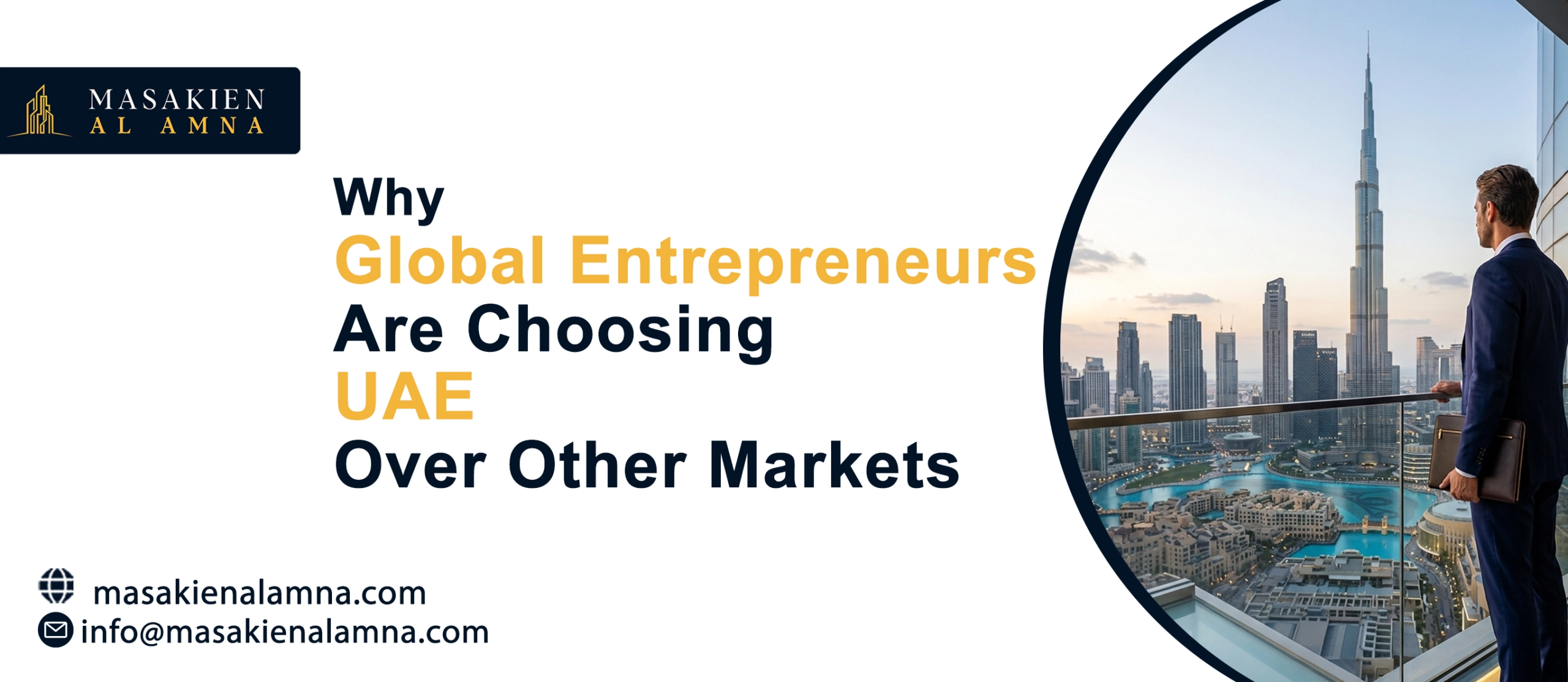
In today’s competitive business environment, entrepreneurs keep looking for markets that feel solid, have real growth, and can support long-term plans. While lots of countries in Europe, North America, and parts of Asia keep pulling in investors, the United Arab Emirates (UAE) has somehow become one of the most welcoming spots for startups, SMEs, and even multinational businesses. Its strategic position, investor-friendly rules, tax advantages, high-quality infrastructure, and mostly innovation-driven economy have helped the UAE stand out as a global business hub.
Whether you’re trying to build a technology startup, expand an e-commerce brand, open a consultancy, or invest in manufacturing, the UAE gives you an ecosystem that’s meant to back business momentum. Government programs and company setup steps that are often streamlined, plus easy access to international markets, have made the place feel like a magnet for entrepreneurs coming from basically everywhere.
This blog sort of breaks down why entrepreneurs worldwide pick the UAE instead of other markets and also how setting up in the Emirates can open up exceptional growth paths.
Strategic Location Connecting Global Markets
One of the most obvious reasons entrepreneurs choose the UAE is the geographical edge. The country sits between Europe, Asia, and Africa, so it works like a doorway to more than two billion consumers within just a few hours by plane.
For firms tied to international trade, logistics, online commerce, manufacturing, or exports, this positioning matters a lot. It can lower shipping delays and reduce transportation expenses.
With one operating base, companies can serve customers across the Middle East, Africa, South Asia, and Europe. Also, there’s a kind of practical advantage where travel, routes, and market reach feel more connected than in many other regions.
Business-Friendly Government Policies
The UAE government keeps rolling out reforms that, you know, push entrepreneurship and foreign investment. In lots of places, business rules can become complex, slow, and kind of draining, but here the company registration is more streamlined, and the legal frameworks are fairly clear and transparent.
Entrepreneurs can set up a business faster using online portals, plus they receive government support, and they also get access to digital licensing services. Over time, the commercial laws keep getting updated, so investor confidence gets a lift because the environment feels predictable and secure.
Also, government initiatives that back innovation, artificial intelligence, digital transformation, and sustainability have opened up fresh chances across several sectors.
100% Foreign Ownership Opportunities
Not long ago, many businesses were expected to rely on local sponsorship for mainland operations. But now, with major legal changes, 100% foreign ownership is possible across many business activities.
That shift basically repositioned the UAE into one of the more entrepreneur-friendly destinations in the region. For international investors, it means more direct control over their companies, day-to-day business decisions, profits, and expansion plans.
When entrepreneurs hold full ownership, they tend to get more room to maneuver, more certainty, and better long-term investment potential, compared to several competing markets.
Attractive Tax Benefits
Tax efficiency is still one of the biggest reasons global entrepreneurs come to the UAE to build companies. If you compare this with many countries that deal with higher corporate and personal tax levels, the UAE taxation approach looks more competitive.
Businesses tend to benefit from relatively low corporate tax rates, at least when the applicable regulations are followed, while individuals in general don’t pay personal income tax. That financial lift really helps entrepreneurs put more profits back into growth—like expansion, innovation, marketing, and hiring- instead of seeing it leak away early on.
Also, the UAE keeps a lot of double taxation agreements in place with countries around the world. In practice, this kind of framework allows international businesses to optimize cross-border operations, and it can ease tax burdens in a way that feels a bit more predictable. Check out our latest blog post on Can You Still Make Money From Dubai Property in 2026?
World-Class Infrastructure
Infrastructure matters a lot for whether a business can actually work smoothly, and the UAE keeps landing near the top internationally when people measure the quality of infrastructure.
You get modern office spaces, smart city systems, high-speed internet, advanced telecom, efficient transport networks, international airports, and globally recognized seaports, basically a mix that supports daily operations without too many headaches.
And whether you’re operating from Dubai, Abu Dhabi, Sharjah, or another emirate, entrepreneurs still get dependable infrastructure that supports productivity and international competitiveness too.
Access to Global Talent
A successful business often depends on skilled people, not just ideas. The UAE pulls in qualified professionals from all over the globe, so it ends up building one of the world’s most diverse workforces in a pretty natural way.
People in technology, healthcare, finance, engineering, construction, hospitality, digital marketing, and other fields move to the UAE because of career opportunities and a high standard of living.
That multicultural workforce makes it easier for companies to hire employees with international know-how, while also serving clients coming from different cultural and language backgrounds, which is not a small thing.
Thriving Startup Ecosystem
The UAE has slowly built up a really vibrant startup atmosphere, helped along by incubators, accelerators, venture capital firms, angel investors, and government-backed innovation programs. It’s not just one thing; it’s more like a whole mix working together, you know.
Founders who launch technology companies, fintech solutions, AI platforms, SaaS businesses, health-tech startups, and green technology ventures can tap into funding chances, mentorship support, and a steady stream of networking events, plus innovation hubs. The government also pushes entrepreneurship pretty actively, and that is one reason the UAE is now considered among the fastest-growing startup destinations in the Middle East.
Diverse Free Zones for Every Industry
Another big plus is that there are free zones tailored for pretty much every type of activity. These business zones come with lighter regulations, sector-specific infrastructure, tax incentives, and usually quicker licensing processes, which honestly make a difference early on.
Tech firms, media agencies, healthcare operators, logistics companies, educational institutions, manufacturing businesses, and financial organizations can select a free zone that matches how they actually run day-to-day operations.
That kind of specialization makes it easier to work inside ecosystems that encourage cooperation, informal connections, and business expansion, instead of everything feeling random.
Digital Transformation and Innovation
The UAE has positioned itself as a global reference point for digital transformation. Government services are getting digitized more and more, so businesses face less paperwork, and operations tend to move faster.
The country also places steady emphasis on artificial intelligence, blockchain technology, smart city plans, cloud computing, cybersecurity, fintech, and broader digital infrastructure. For entrepreneurs working in emerging technologies, this usually means supportive regulations, innovation-leaning policies, and a market that’s genuinely eager to adopt new solutions.
Flexible Business Growth Opportunities
Many entrepreneurs start their day-to-day business in the UAE before pushing outward into nearby GCC countries, across Africa, and toward South Asia.
It’s mostly because the country has smart trade agreements, strong logistics abilities, and pretty solid international connections. So moving regionally tends to feel way easier than trying to operate in other markets, where everything can be slower or more scattered.
And then, businesses can scale without so much fuss, while still keeping centralized control, which also cuts down on that administrative back-and-forth and general overhead confusion
Why the UAE really feels different than other markets
|
Factor |
UAE | Many Other Markets |
|
Foreign Ownership |
Up to 100% in many sectors | Often restricted |
|
Personal Income Tax |
Generally none | Commonly applicable |
|
Business Registration |
Fast and digital | Often lengthy |
|
Global Connectivity |
Excellent |
Varies significantly |
| Infrastructure | World-class |
Varies |
| Political Stability | High |
It depends on the country. |
| Startup Support | Strong ecosystem |
Limited in some regions |
| Talent Availability | Highly international |
More localized |
|
Ease of Expansion |
Excellent regional gateway |
Often more complex |
Industries Experiencing Strong Growth in the UAE
Several industries continue to attract entrepreneurs due to increasing demand and government support.
- Artificial Intelligence and Machine Learning
- Information Technology Services
- Digital Marketing Agencies
- E-commerce Businesses
- Healthcare and Medical Services
- FinTech
- Logistics and Supply Chain
- Renewable Energy
- Real Estate
- Tourism and Hospitality
- Education Technology
- Facility Management
- Cybersecurity Solutions
- Business Consulting
Entrepreneurs entering these sectors often benefit from strong market demand, supportive regulations, and expanding investment opportunities.
Common Mistakes Entrepreneurs Should Avoid
- A lot of first-time business owners end up making avoidable errors when they first step into the UAE market.
- One frequent issue is picking a mismatched business license or company structure without really thinking about what comes next later on. If you have future expansion plans, you should not treat them as a small detail. The right choice of jurisdiction, mainland, free zone, or offshore can change day-to-day operations; it can also affect taxation and even how you reach the market.
- Another thing people often overlook is compliance, and not just the simple type. Visa processes, accounting duties, regulatory renewals—all of that can pile up fast if you underestimate it. Many founders find it easier when they work with seasoned business setup consultants because they end up guiding the process more smoothly, and fewer costly delays happen.
- And lastly, businesses should really put money into market research, localization tactics, and digital marketing so they can connect with customers in the UAE, which is diverse and competitive at the same time.
Conclusion
The UAE has basically reshaped itself into one of the most appealing destinations for entrepreneurs by mixing business-friendly regulations with advanced infrastructure, tax efficiency, strong global connectivity, and an innovation ecosystem that keeps moving. Contact us because of this, both new startups and more established companies can launch, scale up, and expand into international markets without feeling like everything is blocked.
While governments across the world compete to pull investment closer, the UAE keeps improving its approach with progressive reforms, digital transformation, and long-term economic planning. Entrepreneurs who want a stable, future-ready, globally connected business environment should see the UAE as an exceptional option.
Frequently Asked Questions (FAQs)
-
Why is the UAE seen as one of the best places for people who start new businesses?
Well, the UAE has a kind of strong global link, investor-friendly rules, modern infrastructure, good tax options, and a fairly supportive startup vibe. All of that makes it feel like one of the top business hubs around the world.
-
Can foreigners own 100% of a company in the UAE?
Yes, in many cases. Quite a few business activities now let foreign investors hold full ownership, so international entrepreneurs can manage their companies directly, without needing a local partner.
-
What industries are growing the quickest in the UAE?
A lot is moving fast in technology, artificial intelligence, fintech, e-commerce, healthcare, renewable energy, logistics, cybersecurity, real estate, and facility management. These areas are often described as some of the fastest-expanding ones.
-
Is the UAE a good fit for startups?
Yes, definitely. The country offers startup-friendly regulations, funding options, accelerators and incubators, plus plenty of networking events and direct access to regional as well as international markets.
-
How does the UAE stack up against other global markets?
Compared with many other places, the UAE tends to offer quicker business setup, fairly competitive taxation, strong infrastructure, political steadiness, and smoother access to emerging markets across the Middle East, Africa, and Asia.