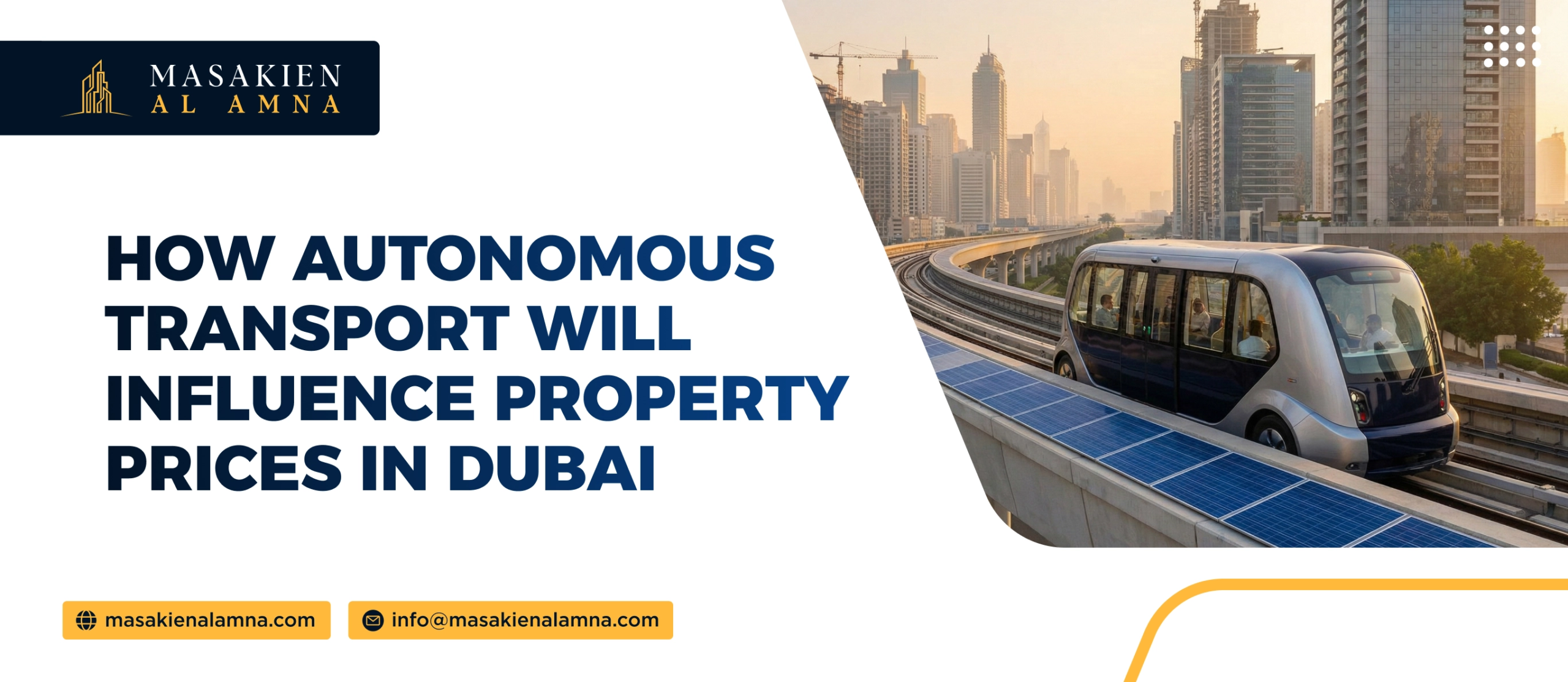
Dubai has a history of setting the pace and keeping the beat in the global race to adopt the future-ready infrastructure. Smart cities and AI-based governance are just some of the technologies that improve urban living and are the city’s regular investments. One of the most influential factors that is now changing the very destiny of Dubai, edging it further and further towards the future, is that of transport automation involving self-driving vehicles, the likes of which are already present in the form of self-driving cars, autonomous taxis, smart buses, and AI-based mobility systems.
With the advent of these transport technologies, people’s living, working, and investing choices would be greatly influenced. This turning point would, in turn, affect the scale of property demand, pricing dynamics, and the overall long-term real estate value exemplarily across Dubai. Let us discuss this impact in detail.
-
Reduced Dependence on Central Business Districts
Prices of properties traditionally located near business centers such as Downtown Dubai, DIFC, and Business Bay went up as a result of the high demand from residents who wanted shorter commutes. The daily traffic jams and long hours spent on the roads made proximity a very important factor in deciding which property to buy or rent. Thus, central locations had premium valuations consistently.
Thanks to the autonomous technology, commuting now is much more comfortable and productive. During the travel, residents can either work, relax, or sleep, and thus the mental and physical burden caused by the long journey is lessened. One will not consider the travel time as “wasted,” hence their willingness to live farther away from their offices increases.
This will gradually reduce the burden on downtown business districts while at the same time creating a more evenly distributed housing requirement in the city. Prices of properties in the suburbs and the outer areas may rise, while the central areas might witness a slower price hike rather than steep increments. The valuation of location will switch from being “distance-based” to “connectivity-based.”
-
Improved Accessibility to Emerging and Peripheral Areas
The introduction of autonomous transport systems has opened up a new era of connectivity that connects areas that were previously very remote or inconvenient. driverless buses, self-driving taxis, and intelligent road networks can quickly and efficiently cater to the less densely populated areas. This greatly reduces the disadvantages that come with living far away from the city center.
Places like Dubai South, Expo City, Jebel Ali, and Al Qudra will be among the areas that gain the most from this technology. The intercity travel from these places will be more fluid, predictable, and less annoying once the desired transport routes are in place. The continued rise in accessibility will result in attracting more people to the area, thereby encouraging housing, retail, and commercial projects.
When there is an increase in infrastructure quality, the demand for the property market also rises along with it. The property prices go up in tandem with the demand that is created by infrastructure improvements. Early investors in these markets might enjoy appreciation that is quite significant over the long haul. The development of transportation for automated vehicles means that the “future areas” are turned into “desirable spots” now.
-
Growth of Autonomous Mobility Hubs
The autonomous mobility hubs are to be the primary areas where all transport modes will converge. These might consist of robotic taxis, intelligent buses, metro links, battery-operated car charging stations, and areas that are friendly to walkers. Just like in the current case between metro stations and property pricing, mobility hubs will be acting as value magnets in the near future.
Real estate properties near these hubs will always benefit from the uninterrupted connectivity and the high volume of people passing by. Such locations will likely appeal to residential buyers due to the comfort and convenience offered; at the same time, commercial businesses will reap the rewards of more customer access. The mixed-use developments that are built around the mobility hubs will attract the high-end buyers and the premium tenants.
Eventually, these places will not just be transport spots but will turn into new urban centers. As the demand for housing increases, property prices around the mobility hubs are expected to rise as a result. Check out our latest blog post on How to Calculate True ROI on UAE Rental Properties
-
Transformation of Lifestyle and Housing Preferences
When people no longer have to endure long and tiring commutes, they start to consider comfort, space, and living in a community as the top priorities. This could lead to a corresponding rise in the demand for larger houses, villas, and places with low population density.
Rather than living in small flats near their offices, residents may prefer surrounding areas that have parks, schools, and places for leisure. Families will be the ones who most appreciate the quiet areas that are still well-connected through smart transport systems. So, this trend might lead to an increase in the demand for suburban areas with good infrastructure.
With the changing of preferences, the prices of properties in communities that are focused on lifestyle will probably go up. The developers will, in turn, react by coming up with house designs that allow for remote working and healthy but balanced living. Autonomous transport has an indirect role in promoting urban lifestyles that are healthier and more fluid.
-
Impact on Commercial and Retail Real Estate
It will not only be the case for offices, retail shops, and distribution centers that they will be able to choose locations that are not only central but also efficient. Better access means that businesses will be able to operate in a larger number of areas and still be highly efficient.
Shops in retail centers that are linked through autonomous transport might benefit from an increase in customers without having to provide huge parking lots. The properties of logistics and warehouses close to the autonomous ways will become more valuable because of the speed and efficiency of the deliveries. This might lead to more demand for the industrial and semi-commercial areas.
-
Influence of Government Planning and Smart City Policies
The government’s vision and urban planning strategies have a huge impact on the real estate market in Dubai. Smart mobility and green living are the major aspects of the city’s long-term development plans, such as the Dubai 2040 Urban Master Plan. Autonomous transport is the main feature in these plans.
The government’s decision to invest in infrastructure or create new transport corridors always triggers a quick response from developers and investors. The areas that are earmarked for the deployment of the autonomous transport infrastructure often see an immediate increase in land value and interest from investors. Development that is guided by policies is perceived as less risky and therefore attracts more investors’ confidence.
The ongoing integration of Dubai’s smart mobility system with more districts is likely to cause a steady rise in property prices in those areas. Savvy buyers who monitor government announcements will be able to spot future growth zones before the prices surge.
-
Sustainability and Environmental Value
The majority of the autonomous transport systems being deployed in Dubai will be electric and eco-friendly. Sustainability is gaining more importance as a factor among modern property buyers.
Real estate located in eco-conscious areas and served by clean transport systems is regarded as an investment that will not lose its value over time. The trend of buyers paying more for homes that are eco-friendly and offer good livability for a long time is gaining popularity among developers, too, who are also including green design in their projects.
Sustainability is likely to be a key factor in which property prices in green, smart-connected communities may outperform traditional developments as the trend goes on. The support of autonomous transport for this trend, as in the case of Dubai’s environmental goals, only strengthens it.
Conclusion:
The use of self-driving cars will change the core of real estate in Dubai, and thus, property prices will be centered on new values. The criteria for purchasing and investing would not only include central locations but also connectivity, accessibility, and lifestyle quality. Places that have been considered remote can easily be turned into hot real estate by introducing smart transportation networks.
Investors who are able to detect the corridors of autonomous transport early will be able to reap the benefits of strong long-term returns. The setting up of mobility networks in the city will allow residents to change their places without losing the advantage of being in a good location. Thus, the Dubai real estate industry will transition into a more harmonious, interconnected, and advanced ecosystem. Contact us as In the forthcoming scenario of Dubai real estate, the criterion will not be how close you are to the city but how good your connection is.