The UAE’s real estate sector, known for its luxury and innovation, has been slowly but surely changed for the better. In the past, property transactions were characterized by a lot of paperwork, complicated procedures, and intermediaries.
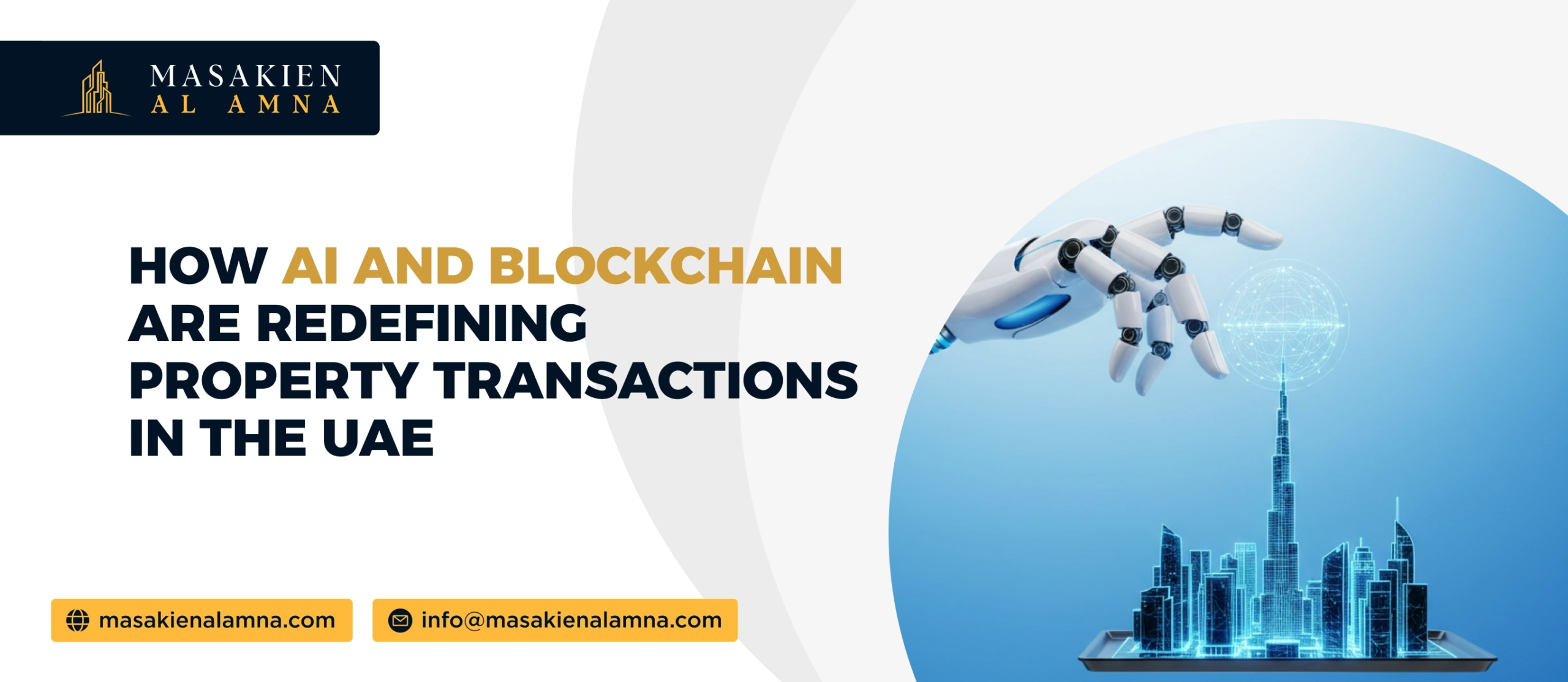
However, the introduction of new technologies like AI, along with Blockchain, has started a process of redefining the very nature of property transactions. These technologies are gradually transforming the whole real estate transaction process in terms of the UAE market’s efficiency, security, and transparency, as well as the consumers’ overall experience.
Understanding AI and Blockchain in Real Estate
Before being able to discuss how exactly AI and Blockchain are making property transactions easier, one has to first grasp what each of these technologies is contributing to the scenario.
AI in Real Estate
AI is the imitation of human intelligence in machines that are programmed to act like humans, learn from experience, and make decisions. AI brings its hands to help in the real estate market through applications like valuation, virtual tours, and predictive analytics.
For example, AI is implemented in the property automation valuation process through AVMs (Automated Valuation Models), which calculate the property’s worth by considering its location, market trends, and its features. Furthermore, AI-driven chatbots and virtual assistants make the purchase and sale process easier for customers by providing them with answers to their questions, as well as personalized suggestions.
Blockchain in Real Estate
Conversely, blockchain is a trailblazing technology that combines digital and decentralized values to provide users with security and transparency. It is simply an unchangeable ledger shared among a network of computers, and that’s how it prevents fraud. During the real estate transactions, Blockchain is being used for innovations like smart agreements, public ownership records, and property fractionation.
The enormous power of smart contracts, which we call self-executing contracts, is really colossal. Not only do they get rid of the middlemen, but they also ensure that every aspect of the contract gets executed by the machine as soon as the conditions are met. On the other hand, the distributed nature of blockchain secures, records, and makes transactions in real estate transparent and public.
The Transparency and Security of Blockchain Enhanced
Smart Contracts
The implementation of smart contracts is one of the most prominent applications of Blockchain technology in real estate. These self-executing contracts automatically perform the execution of the agreement’s terms without taking the help of any intermediate parties, such as notaries or attorneys, once the conditions are set. The case in point is that as soon as the buyer pays for the property, the smart contract will at once and automatically transfer the ownership to the buyer, thereby removing the associated risks and delays of human and manual processing.
The whole transaction process, although automated, might sound tedious, but in reality, it merely promotes the security and trustworthiness of the operation by cutting down the chances of fraud or manipulation.
Immovable Records
A characteristic feature of Blockchain technology is that once a transaction has been committed, it cannot be undone or even diminished in any way. Hence, it is considered very safe, and the comprehensive property transactions are secured by the unchangeable ledger. For instance, the UAE real estate market has previously been plagued by property fraud. Blockchain is very effective in negating such risky scenarios through its presence.
Using Blockchain technology, buyers as well as sellers can view a property’s full transaction history and thus the property is free from any legal disputes or claims. This openness not only creates trust but also lessens the chances of legal issues in the future.
Asset Tokenization
Blockchain enables to tokenization of real estate assets. Tokenization denotes the process of making a physical property into digital tokens, which can then be traded on the blockchain. These tokens symbolize the divided ownership of the property, allowing the investors to buy and sell a property’s shares without having to invest in the whole asset.
The equal sharing of ownership of the property in question makes getting into the real estate market easier by allowing people with comparatively smaller amounts of capital to invest in high-value real estate. The UAE area cannot count on many buyers for luxury real estate; hence, investors worldwide can benefit from the tokenization.
Efficiency in Property Transactions Enabled by AI
Automated Valuation Models (AVMs)
AI-sourced Automated Valuation Models (AVMs) have altered the property valuation process in the UAE completely. AVMs employ machine learning algorithms to ascertain the value of a property after considering several data points such as its location, size, amenities, historical pricing trends, and prevailing market conditions. As a result, accurate and up-to-date property valuations are performed inefficiently compared to traditional methods.
The AI-powered procedure very quickly and fairly provides price estimates that are more precise than the manual appraisal method, therefore benefiting both buyers and sellers. It also supports investors to make decisions based on up-to-date market data.
Predictive Analytics for Market Trends
AI is one of the major factors that constantly influence the market and price movements through its powerful analytics. Also, the application of machine learning methods enables the examiners to have a look at the market’s past data and then forecast future price trends. In this manner, investors and developers will be able to detect the trends earlier than they actually occur. The exceptional quality of being ahead of time, thanks to the AI, has turned real estate agents into figures and fact-based decision-makers, and thus the speculative kind of investing has become less risky.
For instance, an AI-powered system can anticipate an upturn in real estate demand in a particular area by taking into account various factors such as economic growth, infrastructure development, and population increase. This insight helps the investors and developers to get maximum returns from their investments.
Virtual Assistance and Chatbots
AI-powered virtual assistants and chatbots are progressively transforming the customer experience in real estate transactions. These AI technologies are capable of answering questions, organizing property showings, providing market information, and even managing the paperwork associated with the transaction. Chatbots offer a fast and efficient way for customers to enter the real estate market without needing human help, for those who are looking for real estate solutions.
Moreover, the 24/7 availability of these systems means that potential buyers or renters get instant replies regardless of the time. This level of convenience not only enhances customer satisfaction but also makes the entire transaction process more efficient.
AI and Blockchain in Streamlining Legal and Compliance Processes
Automated Document Management
AI in its full extent could take over the entire legal side of property transactions, which would include contract generation and document management. Through AI, legal documents like property deeds, sale agreements, and title documents could be analyzed, and any differences or errors would be pointed out before they cause any delays.
Automated document management systems give assurance that all the required paperwork is in order, thus minimizing the chances of human errors and legal issues thereafter. The automation of these processes makes the transactions of properties faster, and the compliance with the UAE’s real estate laws is also assured due to the use of AI.
Ensuring Compliance
One of the most important areas that Blockchain helps is compliance with the standards set by regulations. In the UAE, real estate transactions have to comply with very stringent legal and regulatory requirements. With Blockchain, every transaction is recorded in such a way that it can be seen and verified, which makes it very easy for the authorities to track and enforce compliance.
Blockchain, by tracking the entire journey of a property through the transfers of ownership and legal documents, ensures that all the aspects of the transaction are up to standard with the regulations. This, in turn, greatly minimizes the probability of regulatory breaches and the resulting penalties.
Faster Transactions
The property transaction process can be greatly accelerated by the combination of AI and Blockchain. Blockchain does away with intermediaries, which in turn lessens the time that would have been spent on paperwork and approvals. In a similar vein, the AI-driven platforms can carry out different sorts of tasks like property search, valuation, and document review, which will lead to quicker decision-making, enabling the process to be quicker.
In a speed-demanding and efficiency-seeking market like the UAE, such technologies are practically facilitating the smoothest and quickest closing of property transactions. Check out our latest blog post on The Role of Artificial Intelligence in Smart Property Management
Real-World Examples of AI and Blockchain in UAE Property Transactions
Dubai Land Department’s Blockchain Initiative
The Dubai Land Department (DLD) project is probably the most remarkable example of Blockchain technology influencing property transfers in the UAE. The DLD is using Blockchain to carry out property transaction data in a way that is both secure and accessible to the whole emirate, thus offering to the public the records of transactions that are transparent and immutable.
In 2020, the DLD launched the initiative of “Real Estate Self-Transaction,” which allowed property owners to register, transfer, and mortgage their real estate through a blockchain-based platform. The whole process has become faster, more secure, and more efficient as a result of this very initiative, thus setting a standard for other countries to follow.
AI in Real Estate Investment
AI is also affecting the property market of the UAE, and it is coming to the real estate sector in the form of AI-powered platforms that give different functionalities to investors. For example, AI helps investors with the analysis of market trends, property values, and risk factors, thus providing the investors with the ability to make informed decisions. Moreover, the manual data collection and analysis process is being taken over by these platforms, hence they can assist investors in making smart decisions and being exposed to lower risk.
The Future of AI and Blockchain in the UAE Real Estate Market
The ongoing development of AI and Blockchain technologies has made the digital and automated future of property transactions in the UAE more certain. The real estate sector—the developers, buyers, and sellers—will likely welcome the AI-empowered and Blockchain-integrated technology by turning to these forms of transaction.
The UAE has shown its commitment to continuously provide the world with new and better things, making it a perfect case for the change in the real estate industry due to these technologies. Nevertheless, there are challenges, such as the lack of regulations, the need for educating people, and the building of supporting infrastructures.
Conclusion
The property transactions in the UAE are being radically changed by AI and Blockchain in terms of efficiency, security, and transparency. Technology is facilitating the whole process from property evaluation and investment decisions to legal compliance and document management.
The UAE, by continuously innovating, is laying down the future of a more convenient and secure property transaction experience. Contact us as the real estate professionals, investors, and buyers in the UAE should take up these technologies that streamlining processes, reducing costs, and providing more transparency in the active property market are just some of their benefits.
Artificial Intelligence and Blockchain will not only be trends in the near future but also the foundation stones of a modernized, efficient, and more accessible real estate market in the UAE.