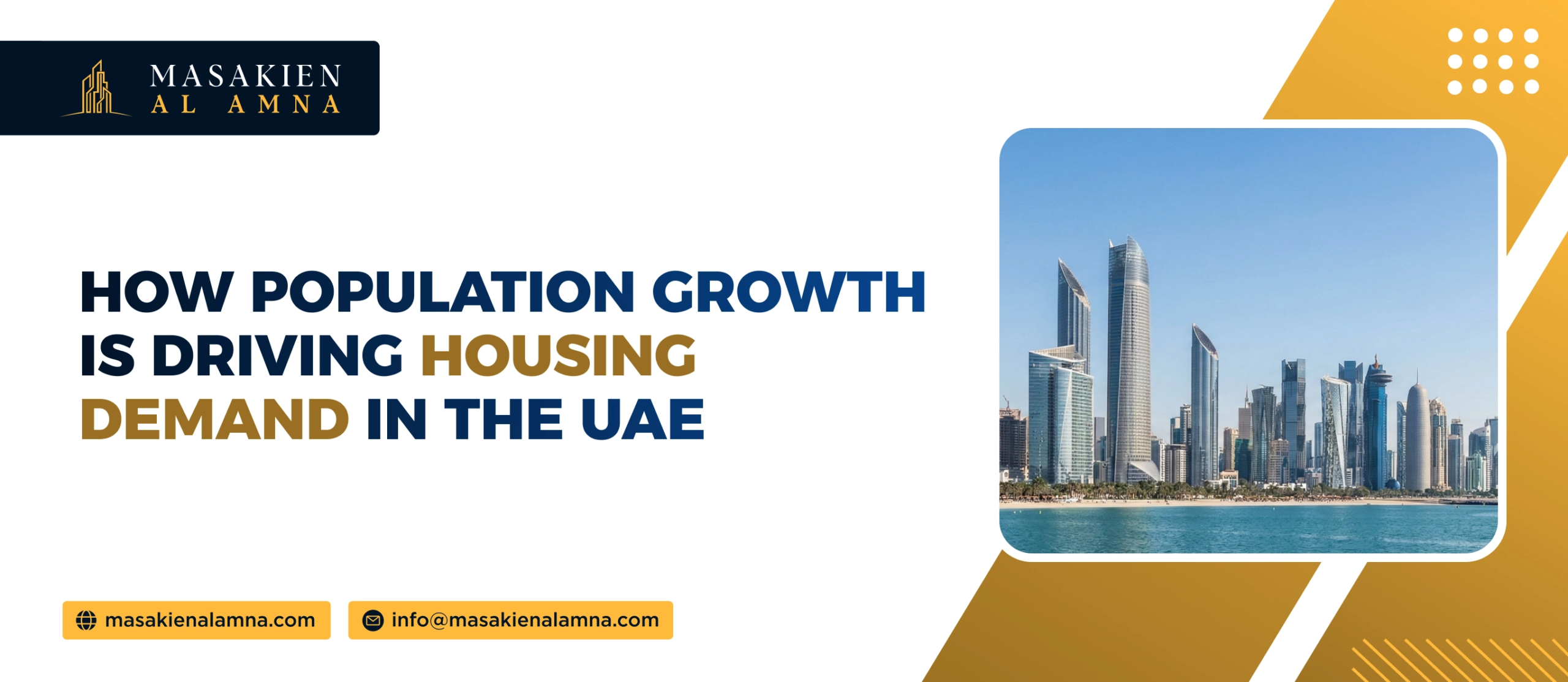
The United Arab Emirates has experienced a significant increase in its population over the last twenty years, making it one of the most active markets for residential real estate worldwide. The cities of Dubai, Abu Dhabi, and Sharjah have turned into global centers for business, tourism, and employment, thereby attracting people from different nations. The continuous rise in the population has a direct impact on the housing demand, and in turn, the residential projects are planned and developed differently.
UAE population growth is not merely a result of high birth rates but mainly due to expatriates relocating for work, education, and lifestyle. The growing population entails the simultaneous increase in the demand for affordable, mid-range, and luxury housing. The increase in demand has led the developers, investors, and government authorities to heavily invest in residential infrastructure.
This post will discuss the factors contributing to the increase in housing demand caused by population growth in the UAE, how this trend is projected to affect the real estate sector in the future, and what this means for the market.
Rapid Population Growth in the UAE
The UAE has been one of the fastest-growing countries in the Middle East in terms of population, placing the major share of credit on the strong economy and the job opportunities. The professionals from Asia, Europe, Africa, and other places migrate to the UAE in hopes of landing up and developers would need to move to the new locales too. The increasing number of people moving into the city has made the pressure on the housing supply more acute.
This swift change in the housing market resulted in the continuing launch of residential projects by developers comprising apartments, villas, and mixed-use developments. If the housing market does not grow this way, then the situation of housing shortage and the sky-high rental fees would be unavoidable.
The Expatriates’ Influence on Housing Demand
Expatriates constitute almost 90% of the UAE’s population and hence, are the main factor of housing demand. The majority of expatriates opt for renting over buying properties, which in turn leads to an increased demand in the rental market of the major cities. The shift of expatriates from renting to buying is happening with the long-term residency options.
Housing preferences vary among different expatriate groups. Single professionals are interested in studio or one-bedroom apartments located in business areas, whereas families like to live in larger apartments or villas that are close to schools and healthcare facilities. The demand generated by this diversity in preferences is spread over various housing segments.
The presence of long-term visas, investment visas, and residency for retirees options has given expatriates much stronger confidence in investing in property. The trend that follows can be characterized as one that is driving housing demand further, particularly in developed neighborhoods and prime locations.
Urbanization and City Growth
Population increase has been the main factor of urbanization in the UAE, especially in Dubai and Abu Dhabi, with migration of people to the cities being the key cause of the increasing demand for housing in the vicinity of workplaces, transport, and commercial areas. This has again been responsible for the construction of high-rise residential towers in the form of vertical expansion.
Cities are not only expanding their heights but also their widths to accommodate the ever-increasing number of residents. Just like the cities, people are moving further away from the urbanized centers and thus, rich suburbia is being redeveloped by the developers to build new neighborhoods, with the existing infrastructure being upgraded in terms of roads and public transport. The city expansions help distribute the housing demand fairly between the downtown areas and the suburbs.
Urbanization provides the incentive for housing projects that are community-oriented and thus will need a lot of amenities such as parks, shops, gyms, and schools. Gone are the days when people wanted just a roof over their heads; they are now looking for complete lifestyles, which in turn dictates the modern housing demand.
Housing Needs Influenced by Employment Growth
The creation of jobs is a key factor in connecting population growth and housing demand in the UAE. The different sectors like tourism, technology, construction, healthcare, and finance, which have been growing rapidly, continue to draw skilled and semi-skilled workers. Housing will be needed immediately for every recruit.
A large-scale infrastructure project, such as the Expo and smart city initiatives, will not only create demand but also bring thousands of workers during both the construction and operation phases. They will require both short- and long-term accommodations, thus putting pressure on the market.
In addition, corporate expansions tend to result in the transfer of employees along with their families. This leads to a continuous demand for family-oriented housing in good residential communities, especially close to the workplace. Check out our latest blog post on Real Estate Scams in the UAE and How to Avoid Them
Demand for Affordable and Mid-Income Housing
The UAE has been experiencing a rapid increase in population, particularly in the mid-income housing segment, which needs assistance in getting affordable housing. This can be attributed to the fact that luxury real estate, while attracting the attention of the media, is not the case with the majority of the population, which consists of middle-income earners. The demand from this segment has been stable throughout the years.
The increase in population has led to the authorities and developers turning their attention to affordable housing, which provides accommodation mainly to essential workers, service staff, and young professionals. Such projects keep the market stable and are a means of preventing drastic rental inflation.
Middle-income housing is also attractive to those longtime residents who want to live in good conditions for a reasonable price. Continuous population growth will characterize this segment as a very active one in the UAE housing market.
Impact of Family Migration on Housing Demand
The UAE has become a family migration destination recently due to its policies and lifestyle changes. The more professionals bring their families, the bigger the houses grow. This includes two- and three-bedroom apartments, townhouses, and villas.
Families’ housing preferences are dictated by proximity to schools, hospitals, and parks. This leads to a shift of demand towards residential community centers rather than isolated buildings. Consequently, developers are now geared towards building family-friendly neighborhoods to accommodate the rising demand.
In addition, family migration brings about increased stability of long-term housing as families are inclined to stay longer than single professionals. Thus, the demand for housing is always there and does not fluctuate from one end to the other due to the regular changes in the living situation of the people.
Government Initiatives Favoring Population Growth
One of the ways the UAE government influences population trends is by implementing attractive policies. One such policy is the granting of long-term visas, which are very favorable to investors, as they can get residency through their business, and the tax-free regulations that are not very stringent to comply with. These measures directly lead to an increase in housing demand.
To encourage home ownership among expats, the government policies have been quite helpful in strengthening the residential real estate market. Areas that are designated freehold zones give foreigners the right to purchase property, which increases the number of property owners.
Furthermore, the investments made in infrastructure, public transport, and smart cities would add to the allure of living in the UAE. The government’s continuous support for population growth would thus consistently maintain a strong and stable housing demand.
Infrastructure Quality and Housing Need
The growth of the population acts as a catalyst for the development of infrastructure, and the latter, in turn, leads to more people wanting to buy or rent houses in the area. Infrastructure improvements give rise to a significant change in the desirability of places that were not very attractive earlier due to the presence of new metro lines, highways, airports, and public amenities.
An improved infrastructure will lead to a demand for housing that will cover new areas, thus relieving the pressure on the city centers. This would open up new possibilities for the project developers to introduce their residential projects in the new areas at lower prices as compared to the city centers.
The demand for housing triggered by the infrastructure development is such that it guarantees an even spread of the growth of cities and at the same time supports the real estate market for a long time.
The Situation of Rental Prices and Property Values in the Future
The growing population will, in turn, lead to the housing supply being unable to catch up with the demand at the same pace, resulting in rent hikes in the most sought-after places. Dubai and Abu Dhabi are among the cities that have experienced rental increases as a result of the incoming population and immediate shortage of supply.
In addition to this, property prices in those areas where the population is increasing steadily will be for the well-connected and established communities. Investors in real estate consider the growth of the population as a major sign of the market’s strength in the long term and the potential for rental yields.
As a result of the necessity to control price hikes meticulously, they will still be creating a healthy and resilient housing market if the population keeps expanding at a steady pace.
Future Housing Demand in the UAE
From the perspective of the future, the population growth in the UAE will still be the strongest, with the help of the country’s economic diversification and global positioning. The government’s commitment to innovation, sustainability, and quality of life development continues to be a magnet for the international community.
The demand for housing will most probably follow the green, tech-savvy, and community-oriented projects. The developers who are in the right place at the right time with the population and lifestyle trends will be the ones to gain the most.
In a nutshell, the growth of the population will always be the most important reason for housing demand, and thus the residential real estate market, now and in the future, will be in the UAE.
Conclusion
Population increase is undoubtedly the most important factor behind the housing demand in the case of the UAE. It is the whole spectrum of population growth, including expat migration, job creation, family settling, and government policies, that results in the rising demand for residential properties. Contact us as thus, the growth has changed the housing preferences, influenced the price trends, and shaped the development strategies.