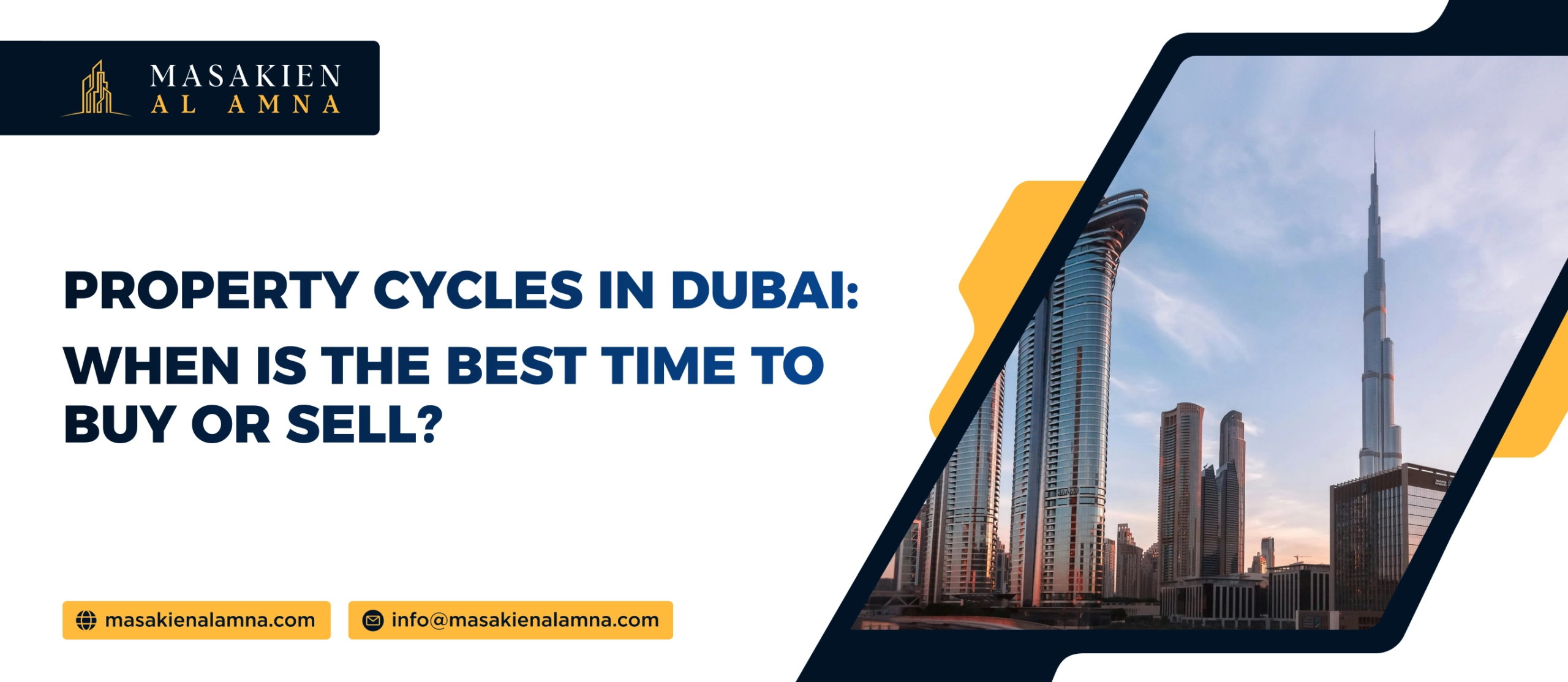
Dubai’s real estate market is one of the most vibrant in the world. Price trajectories often exhibit the characteristics of ups and downs, with a typical pattern of first rising very high, then falling sharply, and then recovering, sometimes even more forcefully than before. With the help of this blog, investors, end-users, and sellers will be able to decipher property cycles in Dubai, making informed decisions by aligning with the trend, which ultimately results in profitability.
The timing of entrance or exit in the market can mean the difference between average return and long-term wealth creation. In this post, we’ll discuss how the market cycles in Dubai work, what the main phases of the cycle are, and how to tell when the right time is to buy or sell.
Understanding Property Cycles in Dubai
A property cycle is the term used to denote the trend where the prices and demand for real estate experience a recurrent pattern of increase and decrease over a period of time. The real estate market in Dubai also goes through cycles that are shaped by the same factors as the global market—these are mainly economic growth, changes in population, government policies, and global events.
Dubai usually has shorter and sharper cycles when compared to established markets. This is because of the quick development and turnaround of demand, mostly driven by investors, and also due to the government’s strong involvement during the downturns. Hence, these cycles are beneficial for the buyers, as they do not pay excessive amounts, and the sellers get the maximum return for their properties.
The Four Phases of Dubai’s Property Cycle
- Recovery Phase
The recovery phase comes into effect after a market slowdown or a correction has taken place. Prices are mostly stable or slowly rising, and consumer confidence among buyers starts to return. The presence of developers is also felt during this period, presenting the buyers with various benefits such as competitive rates, flexible payment schemes, and even other incentives.
Long-term buyers usually prefer this phase since property prices are still comparatively low, rental yields are quite strong, and there is a huge potential for future appreciation. Many times, astute investors would enter the market stealthily during this phase, which is the best time to buy since the future spike in prices will be substantial.
- Expansion Phase
During the expansion phase, the demand for real estate escalates at a rapid pace, which can be attributed to the rise in the economy, migration, new job openings, and the favorable mood of the investors. The prices for properties and the rent for these properties start to go up gradually, and the number of projects launched in Dubai goes up, too.
It is during this phase that investors can reap the benefits of capital appreciation as properties that were bought earlier in the cycle yield great returns or profits. Also, the end-users experience a lot of advantages because of the increasing property values, and the investors are the ones who get the rental income boost, along with the demand for resale.
- Peak Phase
High prices, strong sales activity, and the market’s hopefulness at its highest are the features that define the peak phase. The media is favorable, the investors are rushing in, and the speculative buying is becoming the norm. The situation is that while there is a high demand, the affordability is already starting to become a problem for many buyers.
This is usually the best time for the sellers. The property owners who got in early can sell their properties for the maximum profit. However, new buyers who enter at this point in time run the risk of paying too much, as the prices may already be reflecting the future expectations and not the actual value.
- Correction or Downturn Phase
The correction phase is when the supply surpasses the demand or when external factors like the global economic slowdown or interest rate increases affect the buyer’s mood. Prices are either stable or going down, the number of transactions is decreasing, and the less attractive projects are having a hard time getting rid of their properties.
This phase may look dangerous, but it is also a very good opportunity for cash buyers and long-term investors. Best properties in great locations often come on the market at bargain prices, thus preparing for the next recovery phase.
Best Time to Buy Property in Dubai
The optimal time to purchase is usually the moment of recovery or even the early phase of expansion. These times are characterized by low prices, a smaller number of competitors, and attractive developer incentives like post-handover payment plans or fee waivers.
Purchasing in these periods not only guarantees investors a share in the rental income but also in the future capital appreciation. Besides, the end-users also win by getting the houses at a price they want, which is a scout’s fee before the houses get even higher during the peak demand.
Best Time to Sell Property in Dubai
Selling is usually at its best during the period of peak or late expansion, when property prices are at their highest and there is a strong demand from buyers. Doing so at this time stage will give the seller more negotiating power and will enable them to achieve premium pricing.
Peak cycle selling will make investors able to cash in on their profits before any possible correction takes place. It is also the time most suitable for homeowners who are planning to upgrade or reinvest in modern developments at a later stage. Check out our latest blog post on How Inflation and Interest Rates Impact Property Prices in the UAE
Key Factors That Determine Dubai’s Property Cycles
Government Policies and Regulations
Government interventions are at the forefront of Dubai’s property cycle changes. Long-term residency visas, the Golden Visa scheme, and regulations on foreign ownership have all been means of boosting investor trust. Recognizing and assisting through the downturns, the regulatory support is often an enabler of market demand revival and price stabilization.
Population Growth and Employment Trends
The real estate market demand in Dubai is very much connected with the population growth and the increase in job opportunities. More and more expatriates are coming to the city as a result of the job openings, and that in turn leads to the need for more housing. Thus, high employment growth results in greater demand for rented houses and the occupancy rates remain steady.
Interest Rates and Mortgage Availability
Interest rates are the main factor that determines how much one can afford to buy and their purchasing power. Buying houses becomes easier when the interest rates are lower, which encourages both the investor and the end-user to make a purchase. The more the cost of borrowing goes down, the more the transaction volumes go up all over the market. On the other hand, increasing interest rates can cause the opposite effect, slowing down demand and thus leading to market corrections.
Supply of New Developments
The number of new projects launched is a major factor affecting the property supply and demand balance. If the supply is limited, the property prices have no choice but to rise a little more every day because of the scarcity. The situation when many new launches take place can lead to the supply being more than the demand, resulting in stagnation or even a drop in prices. Proper control of the supply is essential for the health of the market cycle.
Infrastructure Development and Mega Projects
Infrastructure development on a large scale, such as subway systems, commercial centers, and tourist attractions, has a direct impact on the property market. The regions in the vicinity of the new infrastructure gains are always the first ones to experience demand and prices going up. These projects not only improve the connection among different parts of the city but also make it more attractive to live and invest in the area. Thus, indirectly, they are the power that drives up the demand for the whole area in the long run.
Global Economic Conditions
The real estate market in Dubai is always one step behind the mega international economies and their investors. The situation where big markets are doing great automatically invites foreign buyers to Dubai’s upscale residential apartments and villas.
The same global issues can turn the buyer’s market temporarily and push the capital inflow back. But due to the solid fundamentals, Dubai is often among the winners of the race to recover with the least price correction compared to many other global real estate markets.
Long-Term Strategy: Timing vs. Time in the Market
While it is important to get the timing right, long-term success in the Dubai real estate market usually depends on holding through the ups and downs of the market. The prime locations of the highest-quality properties are the first ones to recover and to be the least affected by declines in the market over time.
Investors, instead of waiting for the “perfect” moment, should pay attention to those factors that are location, developer reputation, rental demand, and long-term growth potential. These fundamentals matter more than the short-term price fluctuations.
Conclusion: Making Smart Decisions in Dubai’s Property Market
Dubai’s property market cycles—but every cycle presents the opportunity for the well-informed buyer and seller. Knowing the time of recovery, expansion, or correction of the market will help you to take bold and strategic decisions.
Whenever you’re buying your first home, investing in the property for getting rental income, or targeting to sell for gain, understanding the property cycles can be your way to reduce risk and increase profit. Contact us as the trick is being up to date with the news, having a long-term vision, and making the move when the cycle has arrived.