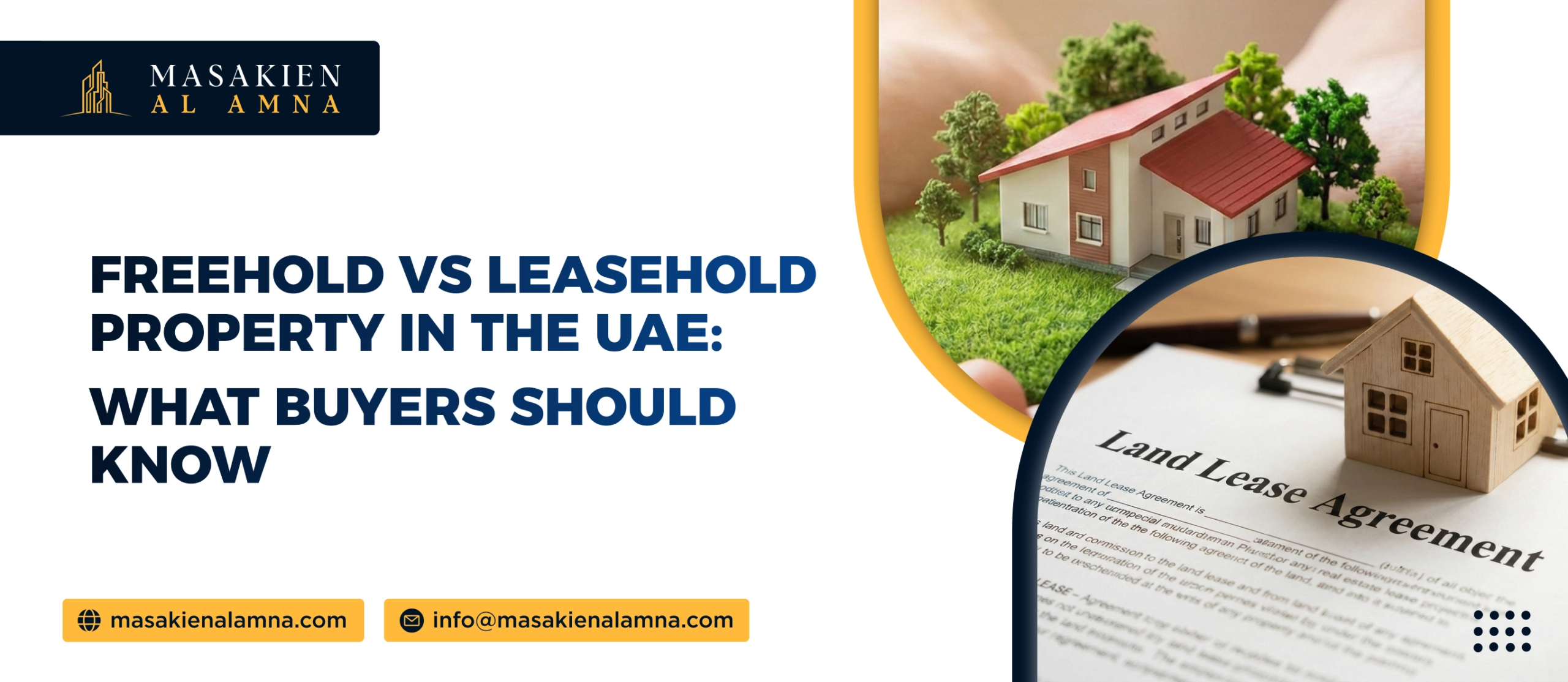
Acquiring real estate in the UAE is a tough decision, particularly for first-time buyers and foreigners who are not familiar with the local property market. One of the main factors that often causes misunderstanding is the difference in ownership rights between freehold and leasehold properties. Although both ways are legally accepted in the UAE, they give very different rights, duties, and benefits over time.
Depending on the type of ownership you choose without being properly informed, it could very well determine the investment returns, the resale value, and even your staying in the property if it is for the long term. This write-up clears up the differences between freehold and leasehold properties for you so that you can make your choice not only confidently but also with good knowledge.
-
What Is Freehold Property in the UAE?
1.1 Meaning of Freehold Ownership
Freehold ownership indicates that the dealer possesses the property and the soil where it is constructed without any time limit. When the property is acquired, it becomes a permanent asset that can be sold, rented out, given, or inherited. The holder gets full control over the apartment within the limits imposed by local construction and community policies. Such property ownership is considered the most powerful and safest in the UAE.
1.2 Who Can Buy Freehold Property
Foreign freehold ownership is permitted in the UAE; however, it is limited to specific spots designated by the government. These areas consist of strategically developed projects that provide the government with control while, at the same time, attracting foreign investment. The buyer has to register the property with the land department to obtain a buying deed. This process not only provides transparency but also protects the buyer by providing the full legal protection offered by the property laws in the UAE.
1.3 Freehold Areas in the UAE
The areas where freehold is permitted in Dubai are Downtown, Dubai Marina, Palm Jumeirah, Business Bay, and Jumeirah Village Circle. The list of Abu Dhabi freehold areas includes Yas Island, Saadiyat Island, and Al Reem Island. The regions are very well developed, thus providing an excellent infrastructure, lifestyle amenities, and high rental demand. Freehold properties are often considered the best choice for capital appreciation.
-
What Is Leasehold Property in the UAE?
2.1 Meaning of Leasehold Ownership
The landowner is generally the original owner or developer. In most cases, when the lease period expires, the ownership is lost unless the lease is renewed. The demand for leasehold properties is higher in older residential and commercial complexes.
2.2 Rights of Leasehold Owners
Leaseholders are allowed to occupy or rent the property during the lease period. A leasehold property can be sold; however, the sale must be of the remaining duration of the lease, which could potentially reduce its market value. Even though the rights are protected legally, they are still not as ample as in the case of freehold ownership.
2.3 Where Leasehold Properties Are Common
The properties under leasehold ownership are found in the older residential parts of the town and in some mixed-use developments. They are generally sold at a price lower than that of freehold properties; thus, they get the attention of buyers who are looking for bargain deals. In addition to being more affordable, lower initial costs also make leaseholds attractive to companies. However, it is crucial for buyers to carefully consider the remaining lease term before making a purchase.
-
Key Differences Between Freehold and Leasehold Property
3.1 Ownership Duration
The periods of ownership in freehold and leasehold properties differ drastically. The freeholder’s title lasts forever, and it can be passed down successively to the heirs without any limitations. In short, the leasehold title is extinguished at the end of the term that was agreed upon. This variation heavily impacts the owner’s estate for planners who think decades ahead. Freehold properties are usually the first choice for buyers who prioritize stability.
3.2 Control and Flexibility
Freehold titleholders are omnipotent over their properties. They can do renovations and choose ways of using the property, within the neighborhood’s regulations. Leasehold titleholders might be subjected to limitations dictated by the landowner or developer. Such limitations could influence the degree of property alteration and the conditions of someday selling the property. For many, the great flexibility offered by the freehold title makes the property more attractive.
3.3 Property Value and Appreciation
Freehold real estate usually possesses a higher resale value and yields more excellent appreciation as time progresses; hence, it is more attractive to the sellers. Conversely, leasehold properties might suffer a decline in value corresponding to the remaining term of the lease, and that would be a turn-off for prospective buyers. Long-term investors would prefer to go for freehold options in order to reap their profit gradually. The market view is that freehold ownership in the UAE is very favorable. Check out our latest blog post on How to Get a Golden Visa Through Property Investment in the UAE
-
Cost and Financial Considerations
4.1 Purchase Price Differences
Generally, freehold properties entail a more substantial initial investment. Nevertheless, the trade-off of buying cheaper properties may be long-term constraints. Hence, buyers need to take into account both the price in the short term and the value in the long run.
4.2 Maintenance and Service Charges
The proprietors of freehold estates are responsible for paying the community service charges, maintenance fees, and other costs. However, it may happen that a leasehold contract assigns certain maintenance duties to the leaseholder depending on the terms of the contract. The amount of these regular costs could be widely different depending on the property’s location and type. It is a must to carefully analyze the service charge details before buying the property.
-
Legal and Registration Requirements
5.1 Property Registration Process
The local land authority should be notified of a change of ownership for freehold estates; the purchaser gets the title deed. A leasehold property is usually treated as an owner for a long time, but not as a full owner. Non-registration of properties can result in confusion, which might cause a loss of money.
5.2 Required Documentation
The buyer must usually produce their passport copies, the sale and purchase agreement, and proof of payment. In the case of mortgages, the buyer should also provide the bank’s approval letter. The purchase of a leasehold property may require the issue of consent from the landowner in addition to the usual documentation.
-
Which Option Is Right for You?
6.1 For End-Users
Freehold properties appear to be the best option for families and individuals who plan to stay in the UAE for a long time. They provide tranquillity, estate rights, and total control over ownership. Leasehold properties are for people who are living temporarily or for those working on short-term projects. The final decision should be based on lifestyle objectives.
6.2 For Investors
Investors generally go for the freehold properties since these come with the advantage of higher rental income and resale value. However, a short-term strategy through leasing in the investor’s area of choice can still be profitable. The line drawn will depend on how much risk the investor is willing to take and for how long they plan to invest. A detailed analysis of the market is necessary before selecting.
Conclusion
The UAE offers both freehold and leasehold properties that are legitimate and commonly used. Contact us as They, however, cater to different types of buyers. Freehold presents the advantages of greater security for the long term and consequently higher values, as well as more room for flexibility, whereas leasehold attracts with lower prices and short-to-medium-term usage.
Buyers need to be knowledgeable about these distinctions so they can save themselves from the inconvenience and costs of making wrong purchases, and at the same time, they can synchronize their purchases with either personal or investment objectives. It is always a good idea to consult someone knowledgeable in the real estate field or a legal professional if you want to be sure that your property choice really accommodates your plans.