

Business development is a concept that is widely popular all over the world, but few can truly understand the meaning behind this term. A business development foundational structure stands on strategy; in short, no strategy, no result.
In this blog, let’s look at the 14 biggest myths of business development and help you comprehend what developing a business really entails in today’s competitive world.
-
What Business Development Really Is
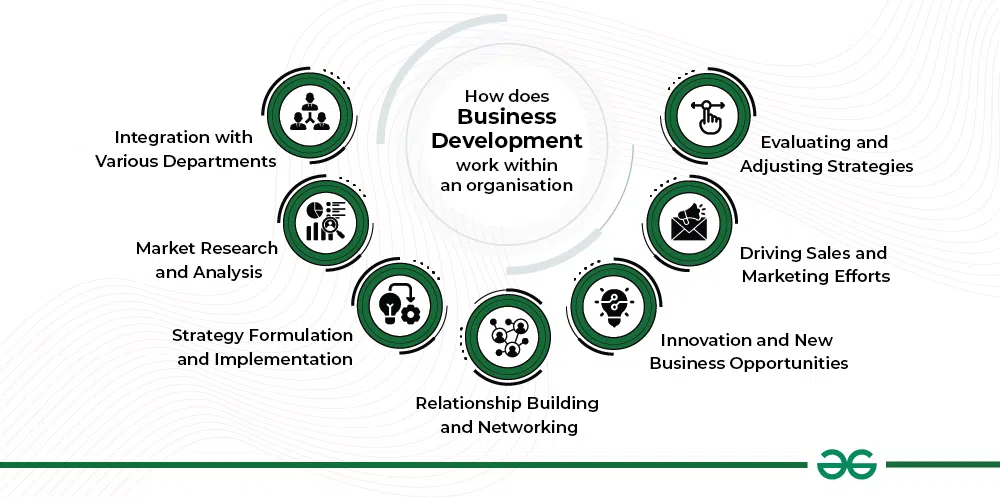
Business development is not merely a department or position. It is an overarching function that covers strategic orientation, relationship building, market insights, and growth planning: Business development marries sales, marketing, partnerships, and operations for sustainable business growth.
Making business development a long-term game rather than running after short wins means creating opportunities for entering new markets, forming partnerships, and creating situations that may never pay off immediately but that will certainly shape the future of the company.
14 Common Misconceptions About Business Development
Myth 1: Business Development = Sales
It is perhaps the most common misconception about the roles of business development and sales. The sales department closes deals and brings in immediate revenue, whereas business development sets in place all the factors necessary for such deals to occur.
The endeavors of business development set out new markets, partnerships, and distribution channels that may eventually serve the sales teams’ objectives. Essentially, Business Growth opens the doors; sales walk through.
Myth 2: It Is All About Networking and Cold Calls
Yes, networking is important; however, business development is not about giving out business cards or making random calls. True Business Development implies conducting research into markets, analyzing competitors, understanding customer needs, and building relationships for mutual benefit.
Modern business development is data-driven—focused on insight, timing, and strategic alignment as opposed to random outreach. An intelligent Business Development professional will know exactly who to contact, when, and why.
Myth 3: Only Big Companies Need Business Development
Many small and mid-sized companies feel that business development is a luxury afforded only to large corporations. The truth is that business development processes are of utmost importance to startups and SMEs; they help them to build alliances, attract investment, and participate in new markets they would not be able to access by themselves.
Actually, effective Business Development could be the very factor making a small company stay small or become a market challenger. Business development has nothing to do with how big or small a company is—it has to do with how big or small a company wants to become.
Myth 4: Business Development Results Are Immediate
Business development has no immediate results. Partnerships need to be built, trust must be gained, and negotiations must be carefully conducted; all these processes take time, and the investment that business development promises to pay out lies in the gradual reward of long-term value.
Good Business Development people are patient—they build relationships and organically nurture them. Quick wins are for the sales team; real growth is from thoroughly tested Business Development.
Myth 5: Business Development Means Generating Leads
Generating leads is one of the many things Business Development does, but it is a little far from all of it. Business Development looks for strategic growth opportunities, jointly works on ventures, examines mergers, and assists with brand positioning.
It has a strategic concern—leads are not just to get leads but to set up systems and networks that keep on generating opportunities. Leads are, therefore, the product but are not the main objective of the development process.
Myth 6: Anyone Can Do Business Development
It is a commonly held belief that anyone with the skill of communication is capable of Business Development, but that is not entirely true. Business development calls for various combinations of strategy, market awareness, negotiation, and long-term relationship management.
It’s a mixture of analysis and creativity. The best Business Development practitioners know the workings of business models, financial impacts, and dynamics involved in partnerships—it’s far beyond just chatting with people.
Myth 7: Marketing and Business Development Are the Same
Marketing centers around visibility and awareness, while business development targets opportunity creation. Marketing puts your brand into the limelight; Business Development converts this limelight into strategic relationships.
These functions are closely linked but serve alternate ends. Business Development without marketing has no audience; without Business Development, marketing goes off course. It is in the best interest of both that they work hand-in-hand.
Myth 8: Business Development Works Only in B2B
Another common belief is that Business Development only works in business-to-business (B2B) scenes. In reality, business development functions equally well in B2C, such as with brand partnerships, influencer collaborations, or loyalty programs.
Take, for example, when a fashion brand collaborates with a leading tech company for a co-branding campaign—there you see business development at work. It is all about finding opportunities that are win-win, be it under any industry model.
Myth 9: It Is Only About External Partnerships
Business development does not just involve external partnerships. It is also concerned with internal alignment—improving cooperation between sales, marketing, finance, and operations.”
If internal teams work better together, the business will naturally develop at a faster rate. Business Development makes sure that both internal and external relationships work seamlessly to create the utmost impact.
Myth 10: The whole business is just about luck and timing.
Many believe that business development is just about luck or being at the right place at the right time; to the contrary. While timing certainly plays a part, the essence of business development rests equally with preparation, perseverance, and foresight in strategy.
Seasoned business development executives would study the markets, assess the competition, and analyze trends well before an opportunity arises. They forecast shifts and take preemptive action, rather than waiting for luck to favor them. Rarely does an opportunity just “stare” at you; it is created through wit, strategy, and hard work. A minute chance might, coyly, play a role; yet insightful planning and a drive to execute weigh much more than a sheer coincidence of price.
Myth 11: Being a Cost Center
Businesspersons usually see development as a kind of department that consumes resources without giving revenue in return. By way of the aforementioned rationalization, another slurred eye is cast on the much-far-later value creation that Business Development spurs.
Business development paves the way for new partnerships, untapped markets, and strategic collaborations that directly affect the growth of the company. Every alliance or foray that turns profitable begins with Business Development activities that lay the groundwork for future revenue. For more insights check out our blog section.
Therefore, from the perspective of Business Development, it is never a cost center; rather, it is a very powerful entity contributing to profit by enhancing brand positioning, creating alternative sources of revenue, and providing a competitive edge to the organization.
Myth 12: The business is a one-person show.
Many organizations allocate the entire business development function to just one individual, expecting them to shoulder responsibility for strategy, execution, and partnerships all by themselves. However, this is an erroneous belief.
True business development is collaborative—requiring input from leadership, marketing, finance, operations, and even HR. Each department contributes a perspective that enriches its growth initiatives.
With this team synergy in place, business development will see gargantuan improvements. It is collaboration, not isolation, that determines what gets done in Business Development in the long term.
Myth 13: Business Development Is Irrelevant in the Digital Era
With the rise of automation, social media, and AI-driven marketing, many held the notion that traditional business development was disappearing into obscurity. In truth, these digital tools have only helped boost the efficiencies of Business Development.
The current business development professional connects with partners and pursues new markets more quickly than ever before by utilizing data analytics, CRM systems, and online communities like LinkedIn. The human element—establishing trust, negotiating, and developing relationships—cannot be substituted by technology, which gets right to the point.
Digital business development has become more intelligent, efficient, and global instead of replacing human strategies.
Myth 14: Instant Results In A Business Development Venture
Business development takes a minimum of months to achieve a number of followers on your website or social media handles. Dreaming of opening a channel and achieving 100 followers overnight is useless. As the development is organic, it achieves building relations of long-term agreement, getting into new markets, and boosting brand reputation, which are all long-term objectives.
One needs to be very patient and use some of the right-wholes alert Key Performance Indicators (KPIs) in rating the performance of Business Development; for example, value to partnership, health of deal pipeline, and traction to new markets. Those businesses that expect an overnight result translate the strategic importance of an instant process.
The effect of business development is shown over time, whereas business development shapes the course, contra-authority, and potential for growth of any business.
Conclusion
In the uncertain world of business, a company can easily run into these misconceptions and end up misinterpreting what ‘business development’ actually means. However, identifying business development as a strategic driver rather than a support function is the beginning of the true business potential.
True business development is building bridges between ideas, people, and strategies to manifest opportunities that just did not exist previously. It flourishes on visions, patience, and collaborative effort—not misplaced faith in luck or guesswork.
When businesses shift their mentality from “quick sales” to “strategic development,” it makes way for growth, not just development. Contact us because we know the end of business development is not closing deals, it is about opening a pathway to an untapped future of opportunities.